







.jpg)
 Share
Share Add fave
Li Jin
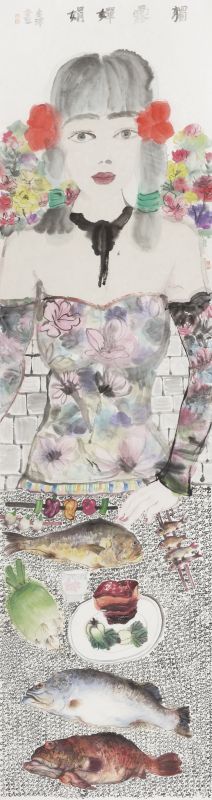
独露婵娟 Noble Solitude
Colour and Ink On Paper, 182 x 48 cm
Chat with us on WhatsApp
About the artwork
The inscription “独露婵娟” draws from classical literary language, evoking ideals of feminine grace, restraint, and poetic beauty. The term “婵娟”, frequently used in traditional poetry to describe elegance or the moon, situates the figure within a long-standing cultural lineage of aesthetic refinement. The opening character “独” introduces a sense of solitude and self-possession, suggesting beauty that exists independently, rather than for display.
In this painting, the female figure is presented with calm directness, her presence both open and composed. Surrounding elements of food and domestic abundance anchor the scene in everyday life, while the inscription elevates the composition through its literary resonance. The result is a quiet dialogue between classical idealization and lived experience.
Rather than idealizing beauty as distant or symbolic, the work presents it as immediate and grounded—an integral part of ordinary existence. Through this balance, Li Jin bridges traditional poetic sensibilities with contemporary visual language, affirming elegance as something personal, present, and enduring.
About the artist
Li Jin (b. 1958, Tianjin, China) is one of China’s most beloved contemporary ink painters, celebrated for transforming everyday moment into colourful, whimsical narratives. A member of the New Literati movement, Li draws on the classical literati tradition and reinvigorates it with vivid humour and modern flair. His expressive brushwork and candid subject matter—full of food, sensuality, and playful self-portraits—redefine the boundaries of traditional ink painting.
Educated at the Tianjin Academy of Fine Arts (BA, 1983), where he later served as Associate Professor, Li Jin has exhibited globally in China, the U.S., Australia, Germany, and beyond. His works are in prestigious collections including the Metropolitan Museum of Art, the Museum of Fine Arts, Boston, Seattle Art Museum, National Art Museum of China, Hong Kong Museum of Art, and Ashmolean Museum, Oxford.
Indeed, even at their most extravagant, Li Jin's pleasures scenes are tinged with the melancholy of solitude and the unreality of a dream or a memory.
