


 Share
Share Add fave
Li Jin
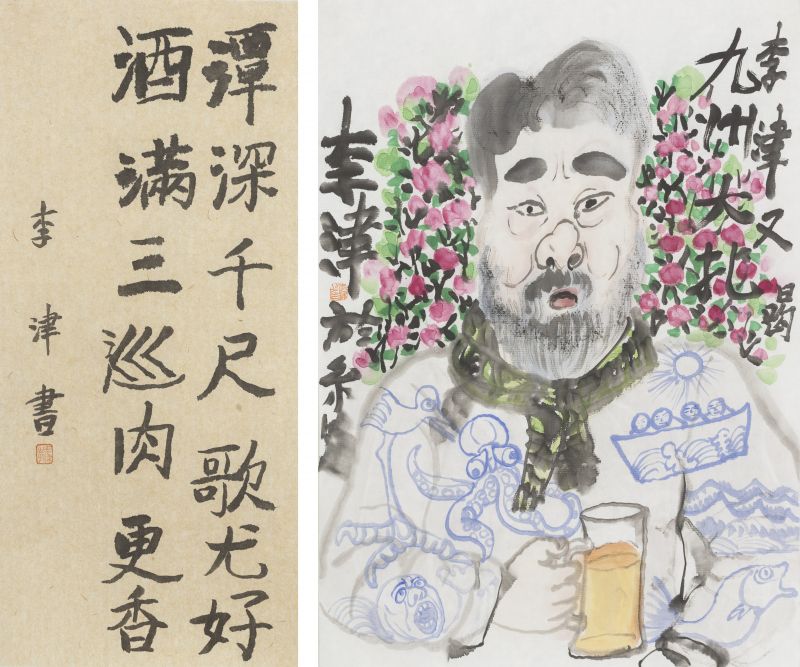
九州喝扎啤 Drinking Draft Beer across the Nine Provinces (Jiuzhou), 2025
Colour and Ink On Paper, 34 x 24 cm
Chat with us on WhatsApp
About the artwork
九州喝扎啤 (Drinking Draft Beer across the Nine Provinces), this work humorously fuses classical literati aesthetics with contemporary life. A bearded figure, loosely rendered in expressive ink, raises a glass of draft beer while surrounded by blossoms and bold calligraphy. The contrast between refined brush traditions and an everyday indulgence creates a playful tension - both celebratory and ironic. Floral motifs soften the figure’s intensity, suggesting vitality, excess, and fleeting pleasure. Through exaggerated expression and spontaneous line, Li Jin transforms drinking into a metaphor for wandering freely through life, embracing indulgence, bravado, and the unapologetic human spirit.
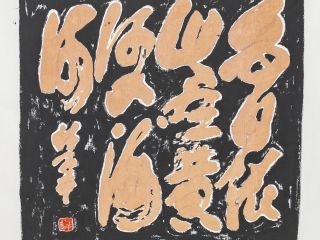
Translation of the Text in the Artwork
Left panel (poetic inscription):
酒满三巡肉更香
千尺歌声可无妨
潭深千尺歌尤好
酒满三巡肉更香
Translation:
Three rounds of wine fill the cups, the feast grows fragrant;
Let the singing rise sky-high—what could it disturb?
Even in a pool a thousand feet deep, song rings truer still;
Three rounds of wine fill the cups, the feast grows fragrant.
Signature:
李津书 – Written by Li Jin
Right side text (title):
九州喝扎啤 – Drinking Draft Beer across the Nine Provinces
About the artist
Li Jin (b. 1958, Tianjin, China) is one of China’s most beloved contemporary ink painters, celebrated for transforming everyday moment into colourful, whimsical narratives. A member of the New Literati movement, Li draws on the classical literati tradition and reinvigorates it with vivid humour and modern flair. His expressive brushwork and candid subject matter—full of food, sensuality, and playful self-portraits—redefine the boundaries of traditional ink painting.
Educated at the Tianjin Academy of Fine Arts (BA, 1983), where he later served as Associate Professor, Li Jin has exhibited globally in China, the U.S., Australia, Germany, and beyond. His works are in prestigious collections including the Metropolitan Museum of Art, the Museum of Fine Arts, Boston, Seattle Art Museum, National Art Museum of China, Hong Kong Museum of Art, and Ashmolean Museum, Oxford.
Indeed, even at their most extravagant, Li Jin's pleasures scenes are tinged with the melancholy of solitude and the unreality of a dream or a memory.